Hello Book Bums families!
This week in the newsletter we are sharing behind-the-scenes information from what makes Book Bums' literacy lessons so successful, to why paragraphs are indented, to why teachers should wear comfortable shoes. You'll also find your favorite features including book recommendations, a simple grammar tip, and fun etymology. Read on and enjoy!
Bookbums.com is an Amazon Associate; We earn from qualifying purchases. This means that if you click on a link to Amazon.com and make a purchase, We may earn a small commission at no extra cost to you. We do recommend the products. Feel free to find them by other means.
Word of the Week
apparition (ap-pa-rish-un) noun/person, place, or thing - a ghostly figure
In Disney's Haunted House attraction, an apparition appears in your carriage near the end of the ride.
Literary Calendar
• Charlotte Bronte's Jane Eyre was published on October 16, 1847.
• This classic of gothic English literature is perfect for an October read. It has stormy nights, spooky houses, tragic illness, romance, and a touch of the supernatural.
• Harry Potter fans will recognize the premise: A young child is orphaned and sent to live with abusive aunt and cousins; later she goes to a boarding school and discovers her talents.
From our Bookshelves

I loved How to Read a Book by Monica Wood. I had no expectations, and I’d even begun reading it (barely) but I stopped to read another. Once I began reading Woods’ novel in earnest, it was difficult for me to put it down. I’m not sure why. There are no big events—nothing keeping me on the edge of my seat—but I had become thoroughly invested in the characters in a wonderful way.
I continually tell my students, and I often say it here, that every time I read a good book, I see a word that surprises me. In this book, the word was hifalutin. Oh, sure, I’d heard the word, but I’d never in my life seen it. I’m not sure what I thought fallootin was, but I’d thought it was high!
I’ve also shared, with the On Your Way podcast, that we need to note and linger with lovely lines alongside our students. In How to Read a Book, the line I stopped to read at least three times was, “As he spoke, the nails spilled to the floor in a tinkling cascade, chiming against the blue pane propped against the wall.” I relished that tinkling cascade and the blue pane propped against the wall because these words helped me to experience the story a bit more tangibly.
I also love when authors use short little words that beget a bigger bang. On page 107, Wood wrote, “I just stand there like a dab.”
I’d inferred that dab meant something small and/or insignificant. When I looked it up, I learned that dab, when used as a noun, means 1) a small flatfish, 2) a dance move or gesture, or 3) a small amount of concentrated marijuana. Dab is also an abbreviation for reference Digital Audio Broadcasting.
So, are we going with the small fish?
The story was captivating, and I learned a dab of something in the process.
If you’re looking for a good read, I definitely recommend How to Read a Book.
Tips for Families

Did you know that you can search the Book Bums newsletters online to find previous newsletters to find something you saw in the past? Go to www.bookbums.com and click on Parents and then Blog or just use this link and type what you’re looking for in the search bar. For example, I looked up skeletons so I could find the word cards that correspond with bone names so I can create a life size, human diagrams with my grandkids. I knew it was in a newsletter, I did the search, and I quickly found the post I was looking for. Easy-peasy!
Here are a couple former newsletters fraught with fall family fun!
https://bookbums.com/cranium/
https://bookbums.com/apparition/
Tips for Raising Readers and Writers

According to Grammar Girl, the impetus for indenting when beginning new paragraphs stems from medieval times.
Before the printing press, when making books, scribes would leave a blank space at the beginning of each new chapter or section of a manuscript so the first letter of that section of the text could be an enlarged and decorated capital letter. Rubicators would then add elaborate letters called initial caps or drop caps (because they dropped down into several lines of the main text), complete with decorative colored markings. Finally, illuminators would fill in any blank spaces, often using gold or silver leaf for added illumination.
The text would be written, leaving a space for the fancy initial letter of the paragraph, but the artists couldn’t keep up, so books were often printed with those extra spaces and only some of the letters fancied up—usually the first paragraph of each new chapter. Cool, huh?
When teaching kids to read, I suggest sharing that the author indents the first line of new paragraphs to signal to the reader that a new character is talking, that time has passed, that there’s a new location, or there’s a new idea.
When there are two spaces between lines, it indicates the passage of time or entrance into a new location. Readers should pause here, even longer than at a period. The indenting is a great cue that oral readers are going to change their voices.
Today, in typography, the pilcrow (¶) is a glyph, or pictograph, used to identify a paragraph. I remember seeing these on a few of my papers in high school. My teacher was sharing when I should have begun a new paragraph.
I use this symbol when conferencing or tutoring with students to indicate the student required assistance with acknowledging paragraph breaks in his or her oral reading. Kids cannot just plow through paragraph breaks as though they mean nothing. When your readers do not slow to acknowledge the direction provided by the author (with punctuation and/or paragraph spacing), you need to share why authors do what they do and that, as readers, we must adjust our reading accordingly.
(TIP: To remember this shorthand notation, just remember it’s a backward P for paragraph.)
Wordology Workshop
• The Greek root typ means stamp or model.
• You can find it in words like typical, archetype (which means the original example or model of something), genotype (which means the genetic makeup or model of an organism), and typography (which refers to the style and appearance of printed material or the stamp of letters).
Practical Grammar

Top Ten Errors Made by Adults Week 7/10
Who vs Whom
TIP: Who – subject Whom – object
TIP: You should be able to insert he or she for who, and him or her for whom.
Example Error: Whom is going to the meeting? We’d say, “He is going to the meeting,” so use who.
Fix: Who is going to the meeting?
Example Error: Who do you believe? We’d say, “I believe him,” so use whom.
Fix: Whom do you believe?
Need a laugh? Click the link for a funny skit featuring who/whom and other common blunders.
News from Book Bums

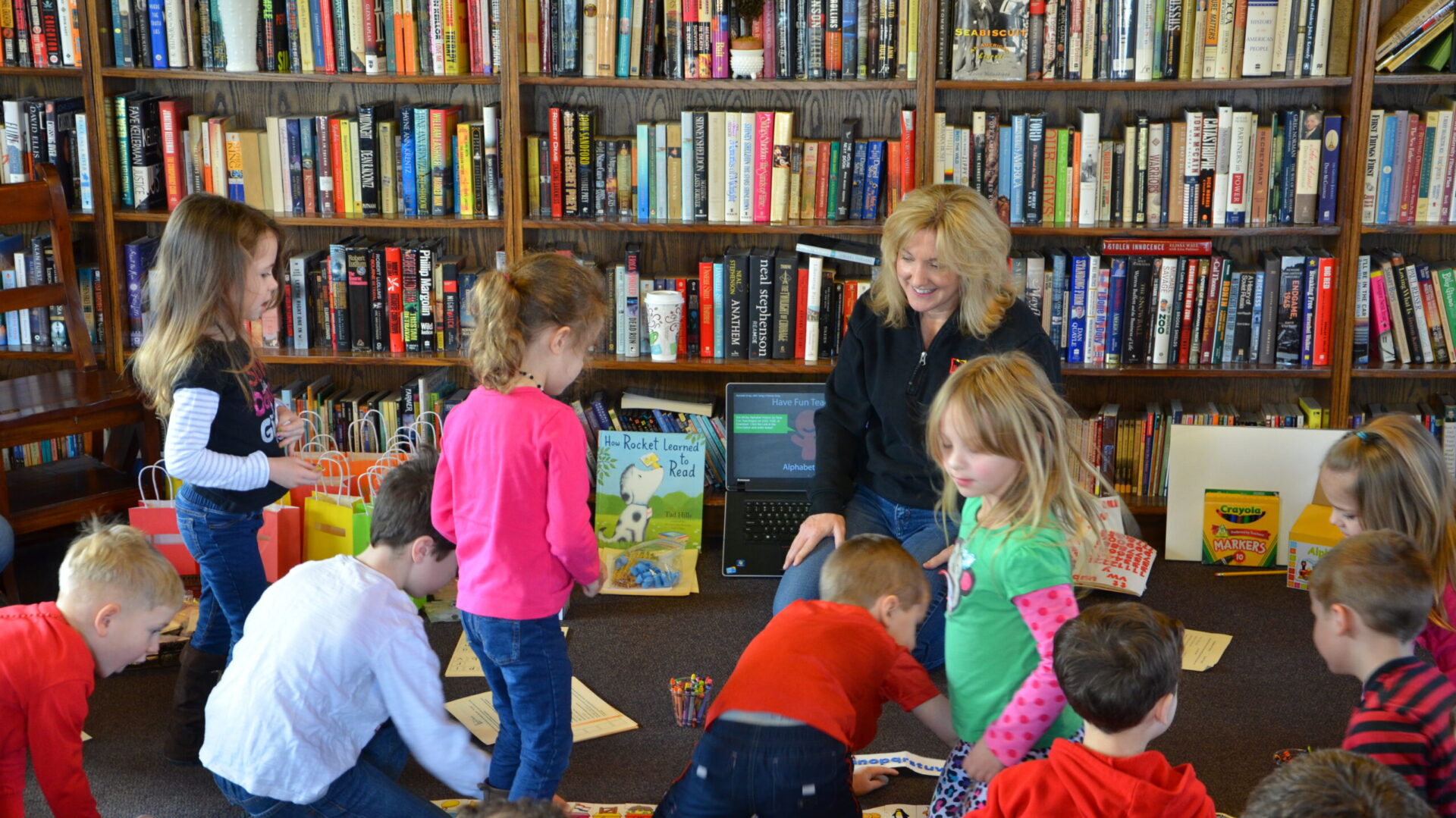
There’s a directive in the science of reading community to “cut the fluff and teach the stuff.” At Book Bums, we strive to make our learning sticky and enjoyable. After all, we want our kids to want to come for tutoring, and we want them to remember the lessons we’re teaching them. (We have only one hour, once a week, to move our students forward!) Though we use cereal bits (shown above) and other crazy tools to launch our lessons, do not mistake these tools as “fluff.” We’re deliberately using environmental print to provide touchstone moments, so our students are equipped to easily recall what they’ve learned. Because every lesson is unique—with its own “gimmick” to promote recall—our students, with very little prompting, remember what we’ve taught them.
After every Foundations for Literacy phonics lesson, our students should be able to
Name the letters.
Make the sounds.
Do the motions.
(E.g., O-r says /or/ like in Oreos. Kids should do the Oreo twisting motion.)
We can accomplish all we do in a single hour because our lessons are memorable, we are clear and concise, we provide plenty of fun-focused practice opportunities, and we always provide spelling tasks to move from decoding (print to speech) to encoding (speech to print).
It’s not fluff if the kids (quickly) get the stuff.
Tips for Teachers

Teachers, ditch the heels and don the sneakers.
Whole group lessons (vs small group) yield superior student progress!
(But you’ve got to get up and get around to all students all day long. Whew!)
I’ve shared that working with students in small groups is not the most effective or efficient way to meet students’ needs.
The primary issue is: What are the students who aren’t in the group meeting with the teacher doing? Too much independent work time (aka busy work) results in students who are not learning or even benefitting from assigned practice work because the practice is not done with a watchful eye of an educator to offer in-the-moment correction.
Students need continual corrective coaching, not independent practice time.
It turns out that quality isn’t enough, when the quantity isn’t sufficient.
With early-stage growth and skill development (such as beginning readers), lots of whole group direct instruction yields greater growth than a bit of small group instruction.
Just for Fun

Which witch/which is which?
If you know someone who would benefit from our newsletter or tutoring at Book Bums, please share this email with them! Thank you.
Copyright © 2024 Book Bums, All rights reserved
Our mailing address is:
7967 Cincinnati-Dayton Road Suite L
West Chester, OH 45069