

Hello Book Bums families!
Do you tend to read more fiction or nonfiction? This week in the newsletter we think about the benefits and challenges of both for students. We also consider the meaning of Memorial Day, and Dr. Christy issues a shopping challenge!
Read on and enjoy.
Bookbums.com is an Amazon Associate; We earn from qualifying purchases. This means that if you click on a link to Amazon.com and make a purchase, We may earn a small commission at no extra cost to you. We do recommend the products. Feel free to find them by other means.
Word of the Week
impervious (im-per-vee-us) adjective/describing word - not capable of being penetrated, damaged, or affected
My jacket is impervious to the rain, keeping me dry in the downpour.
Literacy Calendar
- May 23 is the birthday of American author Mitch Albom, born in 1958.
- Most famous for Tuesdays with Morrie, his books have sold over 40 million copies.
- This PBS interview shares more about his writing and his humanitarian work.
From our Bookshelves
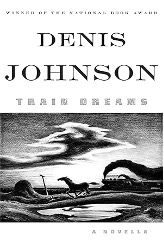
Train Dreams, a critically acclaimed novella written by Denis Johnson, was recently made into a movie. My husband and I watched the movie on Netflix not too many months ago—way back when it was dark by 6 p.m. and we just wanted to snuggle in for the night. We’d had absolutely no expectations for the movie. As the final scene rolled on, my husband and I looked at one another.
Wait . . .
What?
At the conclusion of the movie Train Dreams, we certainly did not experience that satisfying sense of, “Ah. Yes. It’s as it should be.” But perhaps we weren’t meant to experience satisfaction at all.
So many movies today follow that “formula” that we’ve come to expect. They’re tidy and they’re trite.
But when someone (like Johnson) does something differently, it lands differently.
Train Dreams was novel. It was nuanced. And I wasn’t sure I liked it.
I decided to read the book. Afterall, it was a finalist for the 2012 Pulitzer Prize for Fiction. It’s short. You can read it in one sitting. Seriously, it’ll take an hour or two— tops. And it’s got all the makings of a terrific story.
It has love.
The first kiss plummeted him down a hole and popped him out into a world he thought he could get along in—as if he’d been pulling hard the wrong way and was now turned around headed downstream. They spent the whole afternoon among the daisies kissing. He felt glorious and full of more blood than he was supposed to have in him.
It has wonder.
Grainier’s experience on the Eleven-Mile Cutoff made him hungry to be around other such massive undertakings, where swarms of men did away with portions of the forest and assembled structures as big as anything going, knitting massive wooden trestles in the air of impassable chasms, always bigger, longer, deeper.
And it’s relatable.
His elbows cracked loudly when he straightened his arms, and something hitched and snapped in his right shoulder when he moved it the wrong way; a general stiffness of his frame worked itself out by halves through most mornings, and he labored like an engine through the afternoons, but he was well past thirty-five years, closer now to forty, and he really wasn't much good in the woods anymore.
This intimate portrayal of the life of a day laborer in the early 20th-century American West was just beautiful. It’s the perfect portrayal of love and loss for a working-class man during a time when industrialization was rapidly transforming our nation’s land and its people.
Get the book. When you have an hour or so, relax and enjoy a beautiful story of a man’s love and his grief and his ever-changing home. It may be just the somber book you need this Memorial Day weekend.
Tips for Families
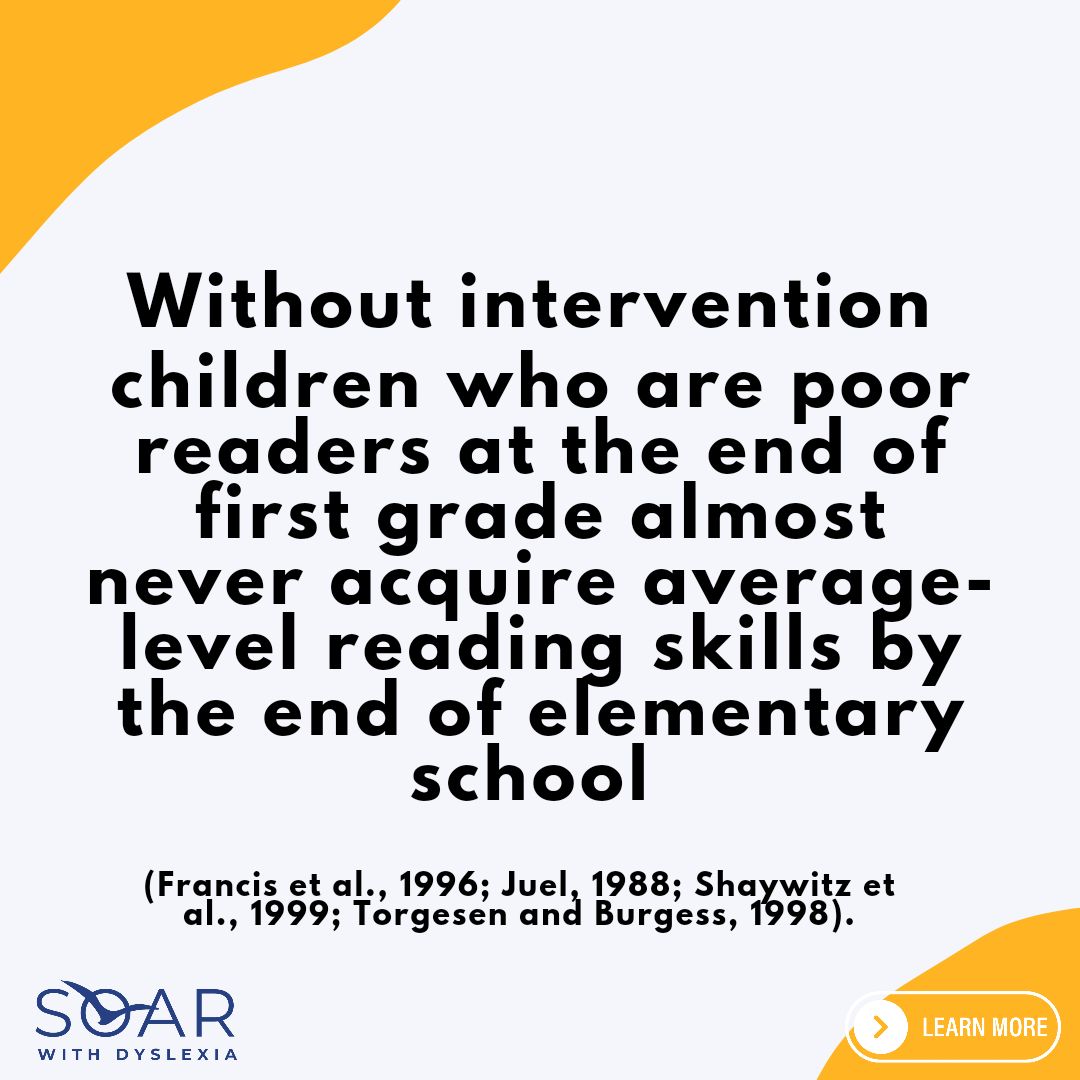
I loved having a café and hosting book clubs and workshops with the express aim of equipping kids (and their families) to be skilled and enthused readers. And I still enjoy working on the newsletters with the broad literacy-content focus. But the message above that says, “Without intervention children who are poor readers at the end of first grade almost never acquire average-level reading skills by the end of elementary school . . .”
This is why Book Bums exists.
The most discouraging part is that when we check the Ohio Report Card information, we are learning that even WITH intervention, far too many kids remain off track.
Go ahead. Click this link and enter the name of your local school. See how many stars out of five your school received for Early Literacy. Then click on that View More Data tab. Then click on Improving K-3 Literacy Measure Details. There you’ll see how many kids actually moved to the place where they no longer need intervention.
Our schools are providing intervention that simply isn’t moving the needle for students. If kids are making gains, it’s just not fast enough to get them on track.
Today, kids are more familiar with phonics. They know more than they once knew. But our students continue to struggle. Though our schools are taking steps in the right direction, they still have far too many students who are struggling with learning to read and spell well.
If your child is in first grade, don’t do the “wait and see” thing. Early intervention is always best. At Book Bums, we have what your child needs to move forward—so you can rest easy knowing your child will soon be a skilled reader and writer.
Tips for Raising Readers and Writers
We adults tend to think more about fictional books when discussing what we’re reading with our friends. In education, there continues to be a greater push toward nonfiction reading. Each, certainly, has its place.
When it comes to kids’ reading, do you imagine fiction reading is more difficult for them, or is nonfiction reading more difficult?
Many folks say that nonfiction reading is more challenging for kids because there’s no predictable and linear plotline, the vocabulary is more specialized, and there’s a great variety of information being shared with text features virtually anywhere on the pages (like images with captions, diagrams with labels, and more), and it can all be a bit overwhelming. If you’ve ever tried reading a nonfiction kids book aloud, you know that it can lead to all kinds of quandaries regarding what to read and what to skip.
Other folks say that fiction reading is more challenging for kids because stepping out of reality can be confusing. Authors can make entire worlds with their words, and fact-focused kids can find it troublesome to navigate the unfamiliar.
We owe it to our kids to equip them for all kinds of texts.
I work with an older student who just learned to read at Book Bums a couple of years ago. We’ve read many books together, and today we’re grappling with Outliers by Malcom Gladwell AND Rowan of Rin by Emily Rodda. To be clear, Outliers is a nonfiction book for adults and Rowan of Rin is a fictional book for beginning chapter book readers. Do you know which is more challenging for my student? Rowan of Rin. It takes place in a make-believe world, with make-believe animals, and the author uses less-familiar names.
It’s a lot to navigate.
In education, while some are pushing all the nonfiction (which I love), I’m over here trying to get a beginning reader to immerse himself in an imagined world. That is a worthy endeavor.
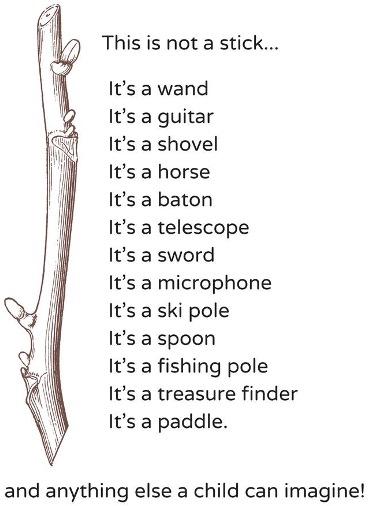
One way to challenge your kids’ creativity is to give them an item and have them come up with as many unique ways of using it as they can. You can start with a stick.
Practical Grammar

Memorial Day
Memorial Day honors military personnel who died in active service. It’s when we honor those who made the ultimate sacrifice in uniform.
TIP: Refrain from saying, “Happy Memorial Day.”
Memorial Day is a day for solemn mourning.
When talking with kids about Memorial Day, try discussing some of these words and their meanings.
courage – n. the ability to do something while being afraid
noble – adj. having, showing, or coming from personal qualities that people admire (such as honesty, generosity, courage, etc.)
grateful – adj. feeling or showing thanks to someone for some helpful act
gratitude – n. a feeling of appreciation or thanks
Wordology Workshop
- The Latin root cor means heart.
- You find it in words such as accord, concord, cordial, and discordant.
- Cor also appears in the word courage, contributing to our idea that bravery means having heart.
News from Book Bums
At Book Bums, we’re still hiring teachers for summer school. If you are a teacher or you know a teacher who’d like to earn some extra money this summer, email Dr.Christy at christy@bookbums.com!
But only send us folks your kids would adore, please. We’re really picky about our tutors.
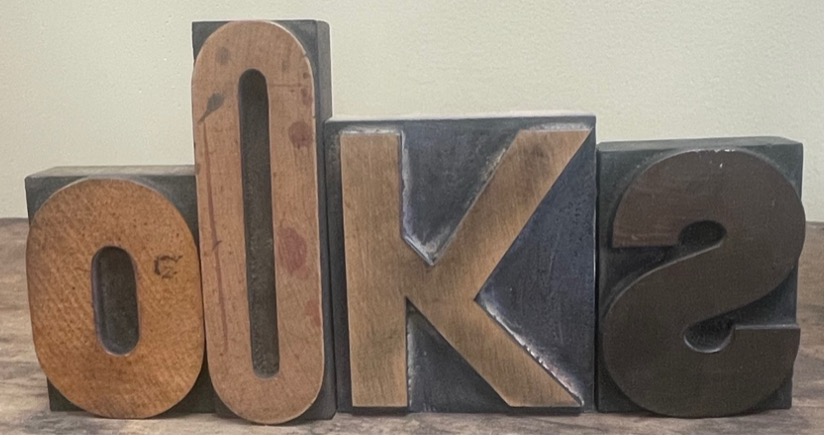
I love anything that has to do with reading and writing, so these wood printing press letters always appeal to me. I found -o-o-k-s, but I need a b to add to our Monroe space. To all my friends who love to shop, if you’re in an antique spot and see a letter b that is about 5” tall, would you please buy it? Then I’ll buy it from you!
Tips for Teachers

It’s just about time to wrap up this school year and tie it with a bow.
Teachers, if you’re working with kids, you owe it to yourself and to your students to work on your own reading, your own writing, and your own well-being this summer.
Here are five top tips to make this your best summer break yet:
(To make it even better, invite your own children to do these along with you!)
- Get a cheap old notebook and write in it every day. Write anything you’d like to explore more deeply. It could be your own childhood memories, what you’re learning in a class, or simple reflections about what you’re reading. Date every page, and work to craft one great sentence each day.
- Read at least a bit of a book every single day. Read something that will make you smile and read something that will make you smarter. Every. Single. Day.
- When you see a word and it catches your eye for any reason whatsoever, ask yourself if you can explain why the word is spelled the way it’s spelled. If you can explain it, great. If you can’t, dig deeper and learn how it works. (You can email Dr. Christy for support with this one!)
- Eat real food and enjoy it out of doors. And can we please make No-Tech meals our new thing?
- Move more—out of doors— as often as you’re able.
Just for Fun
If you know someone who would benefit from our newsletter or tutoring at Book Bums, please share this email with them! Thank you.
Copyright © 2024 Book Bums, All rights reserved
Our mailing address is:
7967 Cincinnati-Dayton Road Suite L
West Chester, OH 45069