
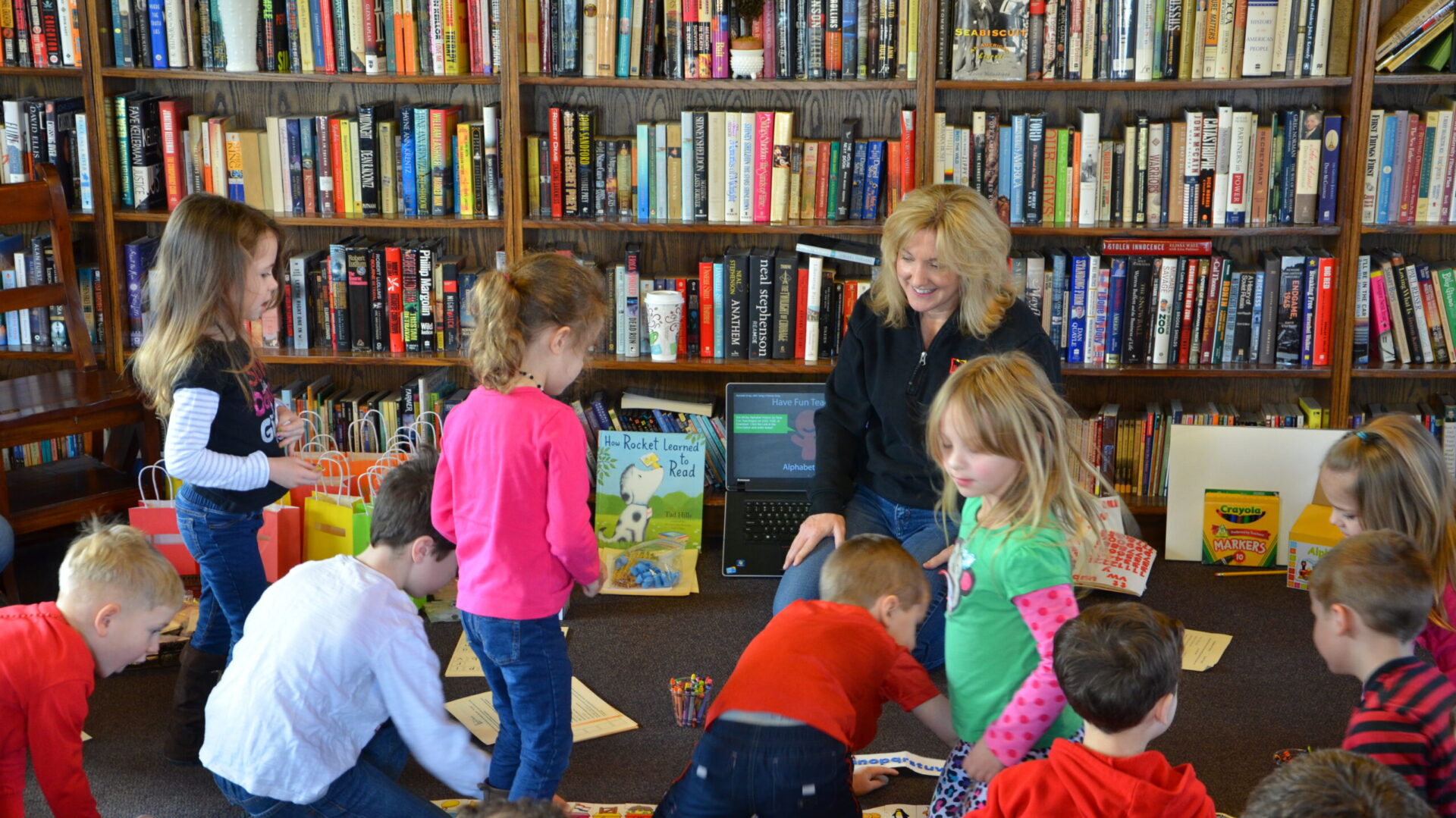

Hello Book Bums families!
This week in the newsletter we are focused on school skills. Dr. Christy shares the dos and don'ts of parent/teacher conferences, tips for spelling tests, grammar for grown-ups, and a trio of books on building good habits.
If there's something you'd like to see in an upcoming newsletter, let us know by responding to this email. We love to hear from you!
Bookbums.com is an Amazon Associate; We earn from qualifying purchases. This means that if you click on a link to Amazon.com and make a purchase, We may earn a small commission at no extra cost to you. We do recommend the products. Feel free to find them by other means.
Word of the Week
strive (strihv) verb/action word - to give serious effort, to try hard
Scouts strive to be helpful, loyal, and prepared.
Literary Calendar
- On September 5, 1957 Jack Kerouac's On the Road was published.
- On the Road tells the story of the author's travels across the American West and is famous for using stream of consciousness which allows a flow of thoughts and feelings with less structure than traditional writing.
- In the middle grade novel Book Scavenger, Jack Kerouac plays an important role in the main character's family and the mystery of the novel.
From our Bookshelves
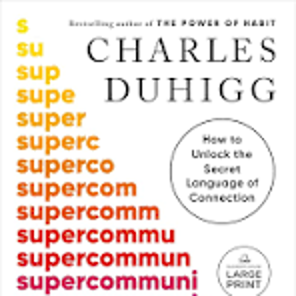
You can tell a new book is out when the author shows up on all your podcasts. I know about Charles Duhigg, because he wrote The Power of Habit; a fantastic book about how we can create habits to simplify our daily routines and make the gains we desire in our lives.
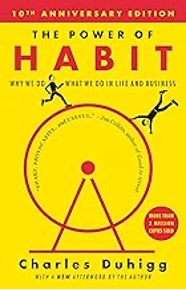
In The Power of Habit, Duhigg shares, in short, that we cue a desired behavior (like setting out our workout clothes) to prompt our brains to engage in the desired habit (working out regularly so we can look and feel better). We feel good about doing what we said we wanted to do (like working out four times this week), and then we determine to enjoy a deliberate reward to remind us of the value in doing the thing we wanted to do (like going out for a delicious smoothie over the weekend). Over time this loop becomes automatic, and we do what we wanted to do without wasting one calorie deciding to do it. Our brains happily navigate our lives requiring the making of fewer decisions.
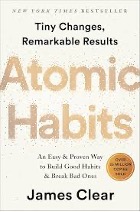
James Clear, in his book Atomic Habits, shared that “habit stacking” is the connecting of one habit to another to reduce the mental effort required to add a new habit you’d like to engage in. An example for me is that when I do my knee exercises, there are some stretches I am required to hold for six minutes for each leg. I began doing my Duolingo Spanish lessons during this time. I’m stuck on the floor, and now as soon as I begin my stretching, I grab my phone and get 12 minutes of Spanish practice in without having to add anything “extra” into my day.
Now, in Supercommunicators, Duhigg steps away from habit building and leans into conversations—why some are successful, while others are busts. He shares that we become more effective at communicating with others when we recognize the three types of conversations and understand and align with those with whom we we’re engaging.
The three communication types are: practical, emotional, and social. When we match the context of the conversation with others, we can foster deeper connections and resolve conflicts. Duhigg shared that one way we can demonstrate that we’re matching others’ conversation type is by “looping for understanding.” This “looping” is accomplished when we: 1) ask questions to encourage a deeper understanding of what is being shared, 2) share, in our own words, what we heard them say, and then 3) ask for confirmation that we got it right.
My sister-in-law, Jan, shared that she enjoys The Jefferson Fisher Podcast, because Jefferson shares practical communication tips that are quite helpful in day to day situations. I now listen to a lot of those episodes too.
You should know that Supercommunicators is less about how to navigate particular conversational situations, and more about the architecture of conversations. Duhigg shares that there are basically three mindsets in conversation. The first one is the “What’s this really about?” conversation where we are negotiating, and a decision-making mindset is required. The second one is the “How do we feel?” conversation where an emotional mindset is required to determine what’s not being said. This can only be realized as we match people’s mood and energy and show our own vulnerability. Finally, there is a “Who are we?” conversation that’s dominated by emotion and requires a social mindset. In these conversations, we must remember our multiple identities to get on equal footing with one another and recognize our common roles.
For me, the most valuable part of the book was learning how to have a conversation with someone during a disagreement. Duhigg shared that when others are skeptical and untrusting of us, it’s often because they don’t believe we’re really listening to what they’re saying. They believe we’re simply planning our own rebuttals. (I’m often guilty of this. Are you, too?)
In Supercommunicators, I learned that when we demonstrate that we’re working hard to understand what others are saying to us and we genuinely try to see things from their perspective—when we prove that we’re listening closely to them—those with whom we’re conversing feel psychologically safe. They come to believe we’re truly trying to understand them, and they trust that we’re considering their ideas based on their worth. It is only when they feel safe and are willing to share their genuine thoughts and ideas that we unlock the secret language of connection and become supercommunicators.
Tips for Families
It’s almost time for school conferences, so I thought I’d offer some ideas to promote a successful time of engaging with your young scholars’ teachers.
Top Ten Tips for a Successful Conference Night
1. Talk with your kids about school and learn their feelings about how things are going so far before the conference.
2. Arrive on time. Whether we like it or not, we tend to make up our minds about people based on limited and even faulty information. Your child’s teacher likely knows very little about you, so begin teaching them about who you are by being on time.
3. Greet the teacher with a genuine smile. Even if you are feeling a little worried about something that’s happened or is happening, greet him or her like you’d like to be greeted.
4. Ask your most important questions first (your time is limited) and listen actively to the teachers’ responses.
5. Ask about your children’s strengths (academic, social, and emotional) as their teachers see them as well as areas that could use some attention and support from home.
6. Take notes. It shows a) you value what the teacher is saying, b) that you take the conversation seriously, and c) you’ll be more inclined to remember what you’ve discussed.
7. Ask how your children are performing compared with their peers and grade level expectations. Gather work samples to take with you to better support your questions if applicable.
8. Be collaborative. Ask how you can best support the teacher’s efforts with your child from home.
9. Dismiss yourself on time. If needed, schedule another meeting.
10. Follow up to say thank you to the teacher and share what you’re doing at home to complement the teachers’ efforts in the classroom.
And the Top Ten Don’ts
1. Don’t make negative assumptions about any teacher. No matter what you may have heard, assume this teacher will be a great one for your child.
2. Don’t bring siblings with you to the conference. Make the child in this class your solitary focus.
3. Don’t engage in small talk. Your time is valuable. Use it wisely.
4. Don’t use your cell phone during the conference time. Be courteous and maintain your utmost focus on what the teacher is sharing.
5. Don’t talk about other children in the classroom.
6. Don’t talk about previous teachers your child has had.
7. Don’t talk about other children’s parents.
8. Don’t talk about your child’s siblings. Maintain a discussion focused on your child alone.
9. Don’t blame the teacher for any possible problem presenting itself. Remain curious regarding any potential issues and listen to the teacher's perspectives before addressing any issues you’re seeing.
10. Don’t feel like you must wait for conference night. Communication with your children’s teachers is an ongoing endeavor.
Tips for Raising Readers and Writers

If your children have weekly spelling tests this year, there are some important things to remember when it comes to helping to practice those word spellings.
You should know that you should not have your students practice spelling words orally. Helping kids to memorize strings of letters is not an effective or efficient way for them to become skilled spellers.
We want our children to practice spelling in the same format it will be assessed—by writing the words.
There are a few basic steps that are essential to promote orthographic mapping. When words are sufficiently mapped in your kids’ memories, they are equipped to recognize when words are or are not spelled correctly and they’ll come to know the words they’re reading “on sight.” They will no longer have to make each discrete sound to discover what the words say.
To learn to spell well and to promote orthographic mapping:
- Have your child say the word they need to spell aloud—even if it’s just a whisper.
- Next, s/he will stretch out the sounds (say the words in slow motion) so each sound is accounted for (e.g., shark = /sh/-/ar/-/k/).
- Then, s/he will represent each of those sounds with letters, making the sounds aloud as they are writing. No letter naming, please. /sh/=s-h, /ar/=a-r, /k/=k
- Ask your child to read back the word, placing a finger under each letter or letter combination to be certain every sound was accurately represented with letters.
- If a word is a tricky one, try to make a connection with something your child knows. For example, many kids haven’t learned that sounds y can make when it’s acting like a vowel. You can say, “This word has a y at the end that sounds like /ee/. That’s what’s at the end of mommy, happy, and crazy too.”
If you don’t know why a sound is represented with a particular letter combination, please feel free to email Dr. Christy at christy@bookbums.com. She can email you to explain the sound and how we teach it at Book Bums.
Of course, if your child is a Book Bums student, you can rest assured that we’ll teach all the letter combinations and their corresponding sounds, so your child becomes a skilled reader and writer.
P.S. Sit with your child and offer support as needed. And please coach them to use proper letter formations as they’re writing. (See last week’s newsletter to learn how to coach into your child’s handwriting.)
Practical Grammar
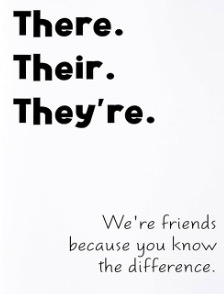
2. Misusing there, their, and they're.
It’s the second week of addressing the Top Ten grammar mistakes made by adults, and we’re addressing the homophones (words with same sounds but different meanings and different spellings) there, their, and they’re.
there- place or existence
their- possessive
they’re- contraction for they + are
Example Error: "Their going to the store."
Fix: "They’re going to the store."
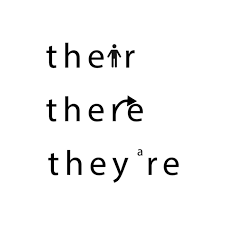
I like the following tip sheet because the words themselves offer some support to help us recall which spelling goes with which meaning.
News from Book Bums

As we prepare to step into our newest Book Bums location in Monroe, Ohio, we’re planning to share everything we can so you get the inside scoop around what it takes to 1) create a great space, 2) share how our tutoring works with a new community, and 3) build a profitable local business that makes a difference for good.
We’re not great about promoting ourselves, but we’re willing to do what it takes so fewer kids feel like they are the reason they’re struggling with learning to read and spell well. We hope you’ll follow along on our journey! We’ll share the social media outlets where we’ll be hanging out very soon.
Pause For Poetry
The Poet Speaks
by John Henrik Clarke
I know there seems to be
Little reason or rhyme
For poets who write of beauty
In such conflicting times ...
But I am one of those who strive to yield,
Golden fruits, from stone fields.
Tips for Teachers

I love this t-shirt, because it acknowledges two of my core beliefs about literacy instruction. Teaching kids to read feels magical, but it requires science.
This is the time of year when we’re getting MAP (NWEA) test scores for our students, and we must make decisions about how to proceed with our classroom instruction. Is my planned Tier 1 instruction going to be sufficient for most students, or do I need to adjust my core instruction? What additional interventions are required to move all students forward. Do I need to stretch beyond my grade level curriculum, or are all students’ academic needs going to be met with the provided curriculum? Or . . . do I need to step back into more remedial instruction because so few students are skilled readers and writers.
It's a high call.
Thank you for meeting your students where they are and determining to take them where they need to be—and beyond.
If you need help, please reach out, and I’ll share Book Bums’ Foundations for Literacy assessment with you so you can make decisions based on what your students already know and what they need next.
Did you know that you can purchase the Foundations for Literacy curriculum on our website? Check it out! Our prices are going to increase in 2026.
Just for Fun

One of the book clubs hosted at Book Bums (the West Chester location) featured the children’s books The War That Saved My Life and The War I Finally Won by Kimberly Brubaker Bradley. I was thrilled because I believe both books to be worthy of adult conversation.
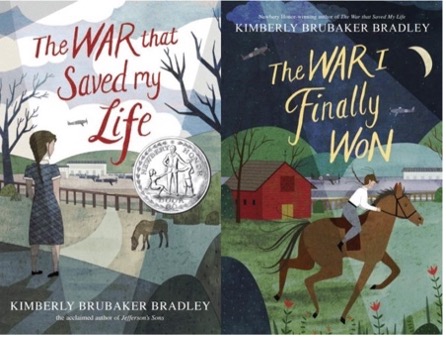
If your kids are assigned a book, I encourage you to read it too. Chances are that you will love it, and you can ensure your children are comprehending what they’re reading. Win-win.
If you know someone who would benefit from our newsletter or tutoring at Book Bums, please share this email with them! Thank you.
Copyright © 2024 Book Bums, All rights reserved
Our mailing address is:
7967 Cincinnati-Dayton Road Suite L
West Chester, OH 45069