

Hello Book Bums families!
This week in the newsletter we share books that made us think twice and get into onomatopoeia with expressive sound words. We also have information on holiday hours.
We are thankful for all of you who have been part of our Book Bums community through the years. Wishing you a lovely holiday!
Bookbums.com is an Amazon Associate; We earn from qualifying purchases. This means that if you click on a link to Amazon.com and make a purchase, We may earn a small commission at no extra cost to you. We do recommend the products. Feel free to find them by other means.
Word of the Week
camaraderie (cahm-rah-der-ee) noun/person, place, or thing - a feeling of friendliness and goodwill
After working together on their meal, there was a happy feeling of camaraderie around the table.
Literacy Calendar
- November is Picture Book Month as well as Native American Heritage Month!
- If you are a a parent, grandparent, or caregiver for little ones, you probably spend a lot of time reading picture books; but if that's not your current role, it may have been a while since you enjoyed the art and language of a well-written picture book.
- Here are two lovely Native American picture books to explore: Ten Little Rabbits by Virginia Grossman and Sylvia Long is a counting book featuring gorgeous, native rugs and blankets. Fry Bread: A Native American Family Tradition by Kevin Noble Maillard explores this delicious food through shape, color, sound, and more.


Pause for Poetry
From our Bookshelves
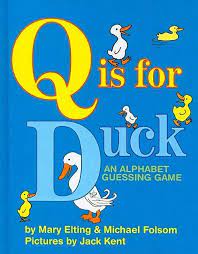
Q is for Duck: An Alphabet Guessing Game, is such an engaging book for kids! Mary Eiting & Michael Folsom wrote this book that, at first glance, may seem a bit wacky, because . . . Why isn’t it D is for Duck? However, when you begin reading, you realize that this book isn’t explicitly teaching kids letter sounds. Rather, it’s prompting kids to think about how the letter q might be related to ducks. So kids need to recall that the letter q (with a u) represents the sounds, /kw/ and then they must think of a word that begins with /kw/ that relates to ducks. I bet you guessed this one. The featured word is quack. One thing I’d challenge my kids to do is to try to think of at least one more word that could work. As I read Q is for Duck, I found that there were times when the word I guessed didn’t match the word in the book. That’s fine too! What a great way to engage kids with letters and the sounds they represent! I love watching kids’ minds at work. Don’t you?
Tips for Families
Often, when teaching our students the short vowel song, a student will say something about the “sometimes y” vowel. At Book Bums, we say that a y is a consonant, but sometimes it acts like a vowel.
The letter y has no vowel sound of its own. When it acts like a vowel, it sounds like an i saying its name (usually at the ends of short little words) or an e saying its name (usually at the ends of longer words). Sometimes y can sound like a short i as we see in the word bicycle. But y has no vowel sound of its own.
That’s what makes this riddle a tricky one.
What’s the longest word that doesn’t contain a vowel?
The word rhythm. (However, that y is acting like a vowel.)
Tips for Raising Readers and Writers

When it comes to promoting reading and writing with kids (and so many other things), Mister Rogers got it right. Establishing an atmosphere that inspires us to grow into who we can be wins over simply insisting on change.
Examine your routines. Is there something you can do to inspire a better version of yourself? Is there something you can do to inspire your family to be better versions of themselves? Here are some ideas I had:
Create a cool book nook for the kids.
Use the “good” dishes.
Enjoy library visits with a milkshake afterward.
Have good, sharpened pencils and a snack ready for homework time.
Be deliberate about a bedtime routine where YOU do the reading.
Meal prep breakfasts so you can relax knowing it’s taken care of.
Place a delightful chair in the sunshine as it pours through the window and read something happy.
Buy the beautiful flowers and place them on the table.
Print some photos that make you smile and leave them around your spaces.
Drink from your favorite mug.
Roll the windows down—even if it’s chilly—and breath in the fresh air.
Post your goals and note how you’ll feel when they’ve been accomplished.
Write notes to your kids and highlight what makes them special.
Make a playlist of your favorite jams and promise to dance for 15 minutes a day.
Go to the antique mall. It’s a walk down memory lane that also counts as exercise.
Practical Grammar

At Book Bums, we teach our students that sometimes r’s can be bossy, and they don’t let vowels make any sound at all. In the word grammar there’s a bossy r that’s not allowing the a to make a sound. We know that a-r usually says /ar/ like a pirate, but sometimes even a-r can simply say /r/.
The best way to learn which vowel is being “bossed” by the r is to notice when it’s happening in the words you observe. Deliberately heighten your awareness of the letter that’s not making a sound and consider a memory device that might help you to retrieve the proper spelling in the future. For example, we share with our students that there is a u in the word turn and we show them this road sign.

For those of us who “just know” which vowel is within a given word—even when no sound is produced, you should know that those words have been orthographically mapped in our memories. We know words are sufficiently “mapped” when incorrectly spelled words don’t look right, we erase something to make a change, and are satisfied that, yes, now it’s right.
Here’s an activity we do with our students to heighten their awareness of vowels being “bossed” by r’s. You can print it and share it with some kids you love, too.
Tips for Teachers
It happens nearly every time I read a book. I see a word that strikes me as odd. Perhaps I hadn’t seen it in a long while. Perhaps never at all. But I grow curious about that word, and I marvel for a moment about its spelling.
Recently, it was the word umbrage that got me thinking. Oh, sure. I’ve heard the word, and I am sure I’ve used it; but I don’t believe I’ve ever seen it. Had I guessed, I might have spelled it umbridge.
To take umbrage means to take offense. Long ago, umbrage was a word for shade or shadows, especially those cast by trees. Today we hear people talk about “throwing shade” when ridiculing someone. Perhaps this is the new way of saying, “I take umbrage with your remarks. You were throwing shade, and I don’t like it. I take offense.” I’m not sure about that, but I’ve now thought about it long enough to make a connection in my mind, and I’m likely to recall my thoughts and spell it correctly.
When we talk with children about our thinking about words, we’re modeling for them how they can reflect upon their own thinking too. It’s beneficial when we talk with our students about how we make connections to recall words and their spellings. This important work certainly promotes oral language and enhances vocabulary development.
Example:
Here’s how I remember the meanings and corresponding spellings of the words discreet and discrete:
discreet: careful with speech to avoid causing offense
The e’s are close together, and I hold information close when I’m close with someone. I avoid sharing potentially delicate information with others.
discrete: individually, separate and distinct
The e’s are separated which reminds me of the word’s meaning.
How do you remember tricky words? Talk about it with your students.
Just for Fun

~Isn’t this the truth?!
If you know someone who would benefit from our newsletter or tutoring at Book Bums, please share this email with them! Thank you.
Copyright © 2024 Book Bums, All rights reserved
Our mailing address is:
7967 Cincinnati-Dayton Road Suite L
West Chester, OH 45069